
Disclaimer: This article is for general informational purposes only and should not be considered legal advice. Always verify current requirements with the Federal Motor Carrier Safety Administration (FMCSA), the Surface Transportation Board (STB), and your state regulatory agency.
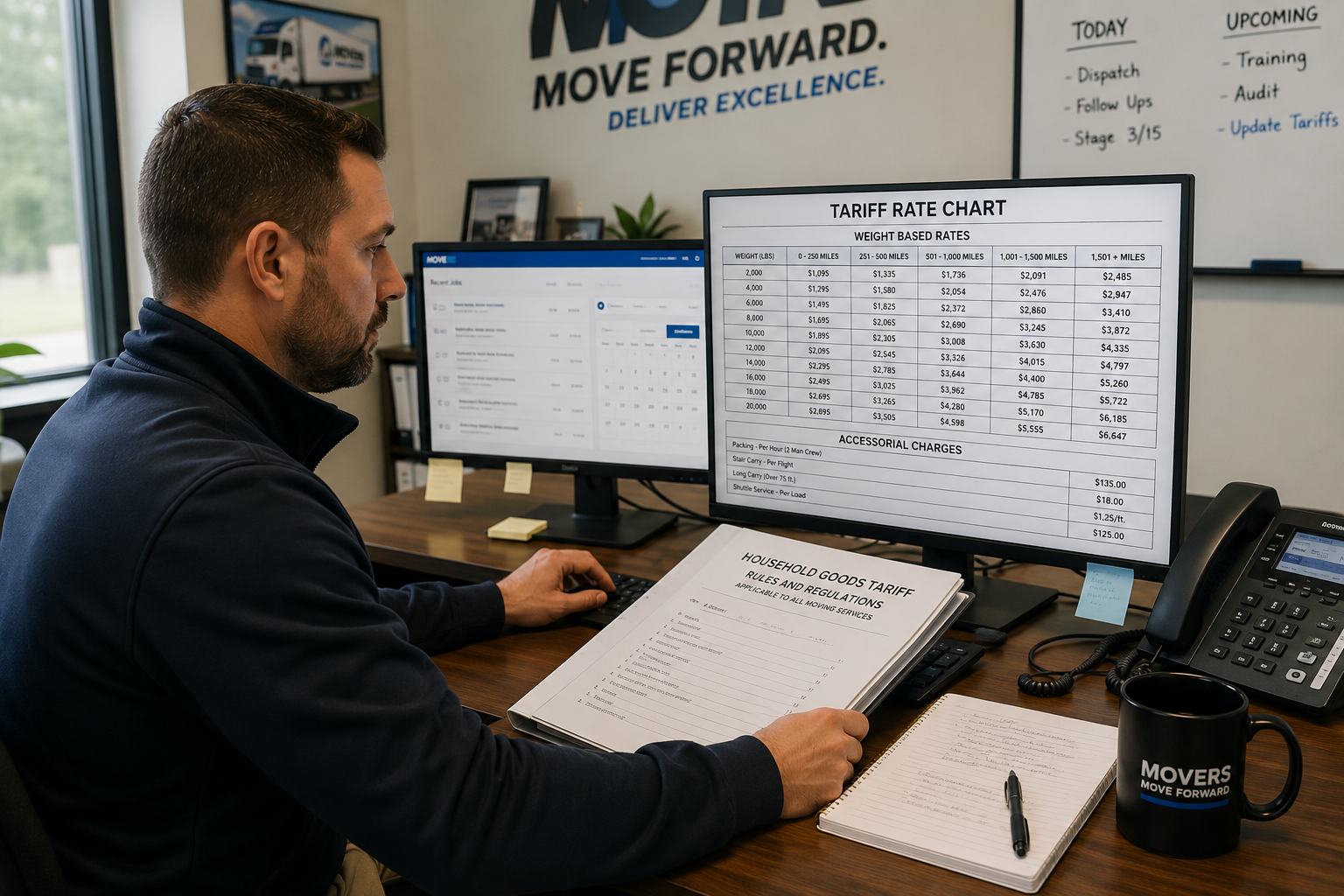
A moving company tariff is the official document that lists every service a mover offers, along with the rates, rules, and conditions that apply to those services. Under federal law, an interstate household goods mover may only transport goods if its rates are published in a tariff that is currently in effect, and any service not listed in the tariff generally cannot be legally charged for. A tariff typically contains rate charts based on weight or volume and distance, accessorial charges, valuation and liability provisions, storage-related fees, and the mover’s operating rules. Interstate movers must make their tariff available to customers upon request.
What a moving tariff actually is
A moving company tariff is the legal rate authority behind your interstate moving business.
Federal law states that a household goods carrier may transport property only if the applicable rate is contained in a tariff that is in effect. In practical terms, the tariff is the master document that governs what services you offer and what you charge for them.

Most interstate mover tariffs are not short documents. They often exceed 30 pages and contain detailed rate schedules, accessorial charges, valuation provisions, storage fees, and operational rules.
Many movers think of the tariff as a compliance document that sits on a shelf. In reality, it defines the boundaries of your business. If a service is not published in your tariff, you generally cannot legally charge for it. That means the tariff directly affects estimating, sales, operations, billing, and claims management.
A properly maintained tariff protects both the mover and the customer by creating a clear reference point for rates and service conditions.
Why it’s required
A tariff is not optional paperwork. It is one of the foundational requirements for operating as an interstate household goods mover.
The FMCSA requires movers to meet several obligations before conducting interstate operations. These include publishing an effective tariff, maintaining cargo liability insurance, and participating in an arbitration program for consumer disputes.
Interstate movers must also provide customers with access to their tariff upon request. The Surface Transportation Board oversees household goods carrier tariffs and the rules governing liability limitations.
Without a compliant tariff, a moving company may face regulatory issues, customer disputes, billing challenges, and potential enforcement actions. Maintaining an accurate tariff is part of demonstrating that your business operates within federal requirements.
What must be included in a tariff
A tariff must clearly explain the rates, charges, and conditions that apply to a shipment. It should be organized so customers can determine the exact charges and service terms that apply to their move.
The following elements typically appear in a household goods mover tariff:
| Tariff Element | What It Covers |
|---|---|
| Rate Charts | Charges based on weight or volume and transportation distance |
| Accessorial Charges | Packing, unpacking, materials, stairs, long carries, shuttles, and other additional services |
| Impracticable Operations | Additional costs caused by unforeseen conditions affecting service |
| Valuation & Liability | Released-rate liability limits and valuation protection options |
| Storage-in-Transit (SIT) | Warehouse handling, storage fees, and related services |
| Rules & Conditions | Payment terms, service conditions, claims procedures, and operational requirements |
Rate charts
The rate section establishes the line-haul transportation charges. These rates are typically calculated using shipment weight or volume and the distance traveled.
Accessorial charges
Accessorial services cover work beyond basic transportation. Common examples include packing services, packing materials, appliance servicing, stair carries, elevator carries, long carries, and shuttle services.
Because these services frequently affect final pricing, they should be clearly defined within the tariff.
Impracticable operations
Sometimes conditions change unexpectedly during a move. An elevator may be unavailable, a truck may not fit near the destination, or weather conditions may create access issues.
Tariffs often contain provisions that explain how additional costs are calculated when unforeseen circumstances make standard operations impracticable.
Valuation and liability
This section explains the mover’s liability options and the customer’s valuation choices.
Customers should understand both the standard released-rate protection available under federal regulations and any additional valuation coverage options offered by the mover.
Storage-in-transit
Storage-in-transit provisions outline warehouse handling charges, storage fees, delivery procedures, and related conditions when shipments require temporary storage.

Rules and conditions
This section establishes the operational framework governing the shipment. It may include payment requirements, claims procedures, service limitations, cancellation policies, and other contractual terms.
Together, these sections create a complete pricing and service reference for both the mover and the customer.
The four documents a tariff connects to
The tariff does not operate in isolation.
Before executing an order for service, interstate movers are required to provide customers with several important disclosures that connect directly to the tariff.
These documents include:
- Your Rights and Responsibilities When You Move
- A summary of the mover’s arbitration program
- A notice explaining the availability of applicable tariff sections
- A summary of complaint-handling procedures
The tariff serves as the official rate authority. These accompanying documents help customers understand their rights, responsibilities, and options while referencing the tariff when necessary.
Many moving companies mistakenly treat these documents as interchangeable. In reality, each serves a distinct purpose within the consumer protection framework established for interstate household goods transportation.
State rules layer on top
Federal requirements are only part of the compliance picture.
Many states impose their own tariff requirements for intrastate household goods transportation. These rules can differ significantly from federal regulations.
For example, Minnesota requires household goods movers to maintain tariffs prepared under federal tariff standards, keep effective tariffs at their principal place of business and terminals, and make them available for public inspection during business hours.
California movers must comply with state-specific tariff requirements under the MAX-4 tariff system.
Because state rules vary widely, movers should review requirements from their state Department of Transportation, Public Utilities Commission, or other applicable regulatory authority. Compliance with federal requirements does not automatically satisfy state obligations.

Keeping your tariff usable day to day
A tariff only works when your daily operations follow it.
Many compliance issues begin when a company’s tariff and quoting processes drift apart. A salesperson may quote a rate that is no longer published. An outdated spreadsheet may contain old accessorial charges. Different team members may apply valuation options inconsistently.
These issues create more than compliance risks. They also create pricing inconsistencies that impact profitability and customer trust.
One practical solution is building tariff rules directly into your operational systems. When tariff rates, accessorial charges, and valuation options are integrated into your estimating workflow, every quote pulls from the same approved source.
For example, movers using a CRM platform can connect tariff data directly to estimate generation rather than relying on individual salespeople to remember rates. Features such as estimating and quote management can help maintain consistency across every estimate created.
The same principle applies to documents. When tariff-related rules and disclosures are built into document workflows, teams are less likely to use outdated forms or omit required information.
The goal is not simply compliance. It is operational control. When tariff updates occur, the changes should flow automatically into the systems your team uses every day.
Common tariff mistakes
Several tariff mistakes appear repeatedly across the moving industry:
- Charging for a service that does not appear in the tariff
- Failing to update the tariff after rate changes
- Not making the tariff available for customer inspection upon request
- Confusing the tariff with an estimate or bill of lading
- Applying accessorial charges inconsistently
- Overlooking state-specific tariff requirements
- Allowing outdated rate sheets to remain in circulation
Most of these issues are preventable when movers treat the tariff as a living operational document rather than a compliance formality.
Key components of a moving tariff
A moving company tariff is much more than a regulatory requirement. It is the foundation that governs your pricing, services, liability provisions, and operational rules. When maintained properly, it protects your business, improves consistency, and reduces disputes.
The most successful movers treat their tariff as an active business document rather than a compliance obligation. Keeping it current, accessible, and aligned with your estimating process helps ensure every quote, service, and charge can be supported when it matters most.
Interested in creating greater consistency between your tariff, estimates, and documents? Consider exploring how modern moving software can help standardize rates and workflows across your operation. Book a Demo to learn more.
Frequently Asked Questions
What is a moving company tariff?

A moving company tariff is the official document that publishes a mover's rates, charges, rules, and service conditions. It serves as the legal authority governing what services the mover can provide and charge for.
Is a tariff legally required?
Yes. Interstate household goods movers must publish and maintain an effective tariff under federal requirements. Operating without one can create compliance and enforcement issues.
How often should I update my tariff?
A tariff should be updated whenever rates, services, accessorial charges, valuation options, or operational policies change. Regular reviews help ensure estimates and billing remain accurate.
How can a CRM help manage moving company tariffs?
A CRM can store tariff rates, accessorial charges, and valuation options in one place so estimates are generated using current tariff information. This helps reduce pricing errors and keeps quotes consistent across the team.
Can a CRM help keep tariff updates consistent across the company?
Yes. When tariff changes are updated within a centralized system, revised rates and charges can automatically appear in estimates, documents, and workflows used by the entire team.
